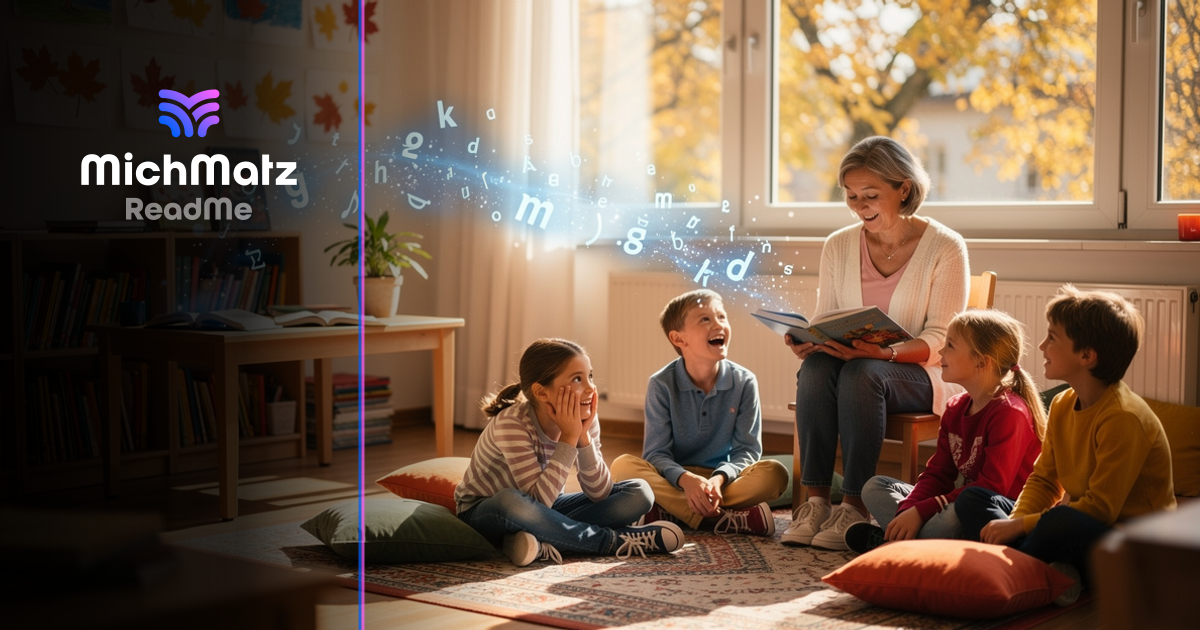
A Read-Aloud Day is quick to plan. The hard part is making sure something of it is still there on the Monday after.
Friday, 20 November 2026, is Germany’s National Read-Aloud Day (Bundesweiter Vorlesetag). For the 23rd time, teachers, parents, grandparents and children read aloud in schools, daycare centres and libraries. In 2023, there were more than one million readers for the first time.
You do not need a project or a project week for this. The five ideas in this article each fit into one class period. Each one tells you what to prepare and whom you can ask.
What happens on 20 November
The day is run by three initiators: Stiftung Lesen, DIE ZEIT and the Deutsche Bahn Stiftung. The 2026 motto is „Ich lese vor – du auch?“ (“I read aloud – you too?”).
The motto does not put the listeners at the center, but the readers. It asks who else is joining in. That is exactly how the five ideas are built: each one is an answer to “you too?”, and in several of them the children read themselves at the end.
Five ideas for a lesson
1. Older children read to younger ones. Your third or fourth grade reads to children from the first grade or the neighboring kindergarten. Each child picks out a picture book and practices it aloud twice. In North Rhine-Westphalia, this practice fits into the mandatory reading time of three times 20 minutes per week, so it does not cost an extra lesson. On Read-Aloud Day, pairs of one big child and one little child then sit spread out around the classroom. Anyone who likes the format can turn it into regular reading buddies with one appointment per month.
2. Parents read aloud, in any language. Invite parents and grandparents into the classroom for fifteen minutes. Each family brings a book, ideally in the language spoken at home. The children who speak that language translate for the rest of the class. That way, the multilingualism of your class becomes the strongest moment of the day.
The idea has a second purpose. According to the Vorlesemonitor 2024, one third of children between the ages of one and eight are rarely or never read to. Read-Aloud Day is an occasion to bring reading aloud back to where it is needed most. Send every family home with the free reading-aloud booklet.
3. The class reads its own story aloud. Collect a topic with your class: the school pet, the last field trip, a dragon in the basement. With MichMatz ReadMe you turn it into a story. If you set “Audio on” during creation, ReadMe reads each section aloud and highlights the text as it goes. The children hear their section first, slow down the reading speed if they want, and then practice it themselves. On Read-Aloud Day, they read the story that is about them aloud to the parallel class or to their parents.
4. Get the library involved or go there. Many city libraries have a school service; Cologne City Library, for example, offers educational programs for schools. Ask your library whether someone can come to the school on Read-Aloud Day or whether your class can come by for a reading session. Call now, not in November. If your school has an open all-day program, it is also worth taking a look at the reading clubs of Stiftung Lesen.
5. The reading relay through the school. At ten o’clock, all teachers swap classes and read aloud for ten minutes. Afterwards, each teacher passes the book on to a child, who reads from it to another child during the next break. The relay needs no partners and no budget, just an agreement among the staff and a note in the staff room. For the school leadership, it is the simplest way to register the whole school for Read-Aloud Day.
A Read-Aloud Day is a good start. Reading only becomes a habit when someone reads aloud and reads independently every week.
And on the Monday after that
23 November is a Monday. The books are back on the shelf, the parents back at work. This is where it gets decided whether Read-Aloud Day was a nice Friday or the beginning of something.
Reading time is already part of the timetable in North Rhine-Westphalia anyway. Take one of the three slots per week for reading aloud and two for independent reading. How to fill the 20 minutes with paired reading and choral reading is described in our article on the start of the school year.
We built ReadMe for reading aloud and reading independently every week. A new story every week about what your class is currently dealing with: the children hear it first and then read it themselves. That way the momentum from 20 November does not just sit on the shelf.
Try ReadMe for free and without signing up and create a read-aloud story for your class. Maybe it will be the one for Read-Aloud Day.
Read aloud on 20 November. Every week from the 23rd.
Das MichMatz Team